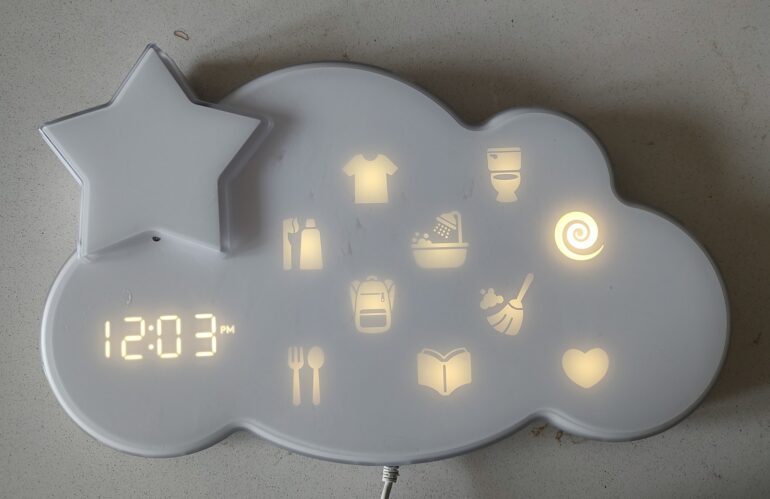
There is a night light in a child’s bedroom. Plug it in, the light comes on, the Bluetooth chip reports for duty as it should. Only there is nothing left to set, because the app that used to do that is gone.
It is the Fisher-Price Lumalou, one of the products in the Smart Connect line. On its own service pages Mattel states: “the Smart Connect product has been discontinued and app support will end on June 6, 2022”. There is nothing wrong with the device itself. The app that made it adjustable is no longer supported.
This is e-waste, it just does not look like it
Most people picture broken devices when they think of electronic waste. More and more often it is about devices that still work, but whose accompanying software has been phased out. An app that disappears from the store, a cloud connection that is switched off, an account that can no longer be created: the result is the same. What made the device more than an object is gone.
The environmental bill for that is a hefty one, because with electronics the impact sits mostly in production. A device replaced years earlier than necessary does not only cost those years of use. A whole new one gets made to take its place.
None of this is a reproach aimed at one particular manufacturer, by the way. Supporting software forever is free for nobody, and at some point a line is drawn somewhere. The point is what happens to the hardware after that.
What we did about it
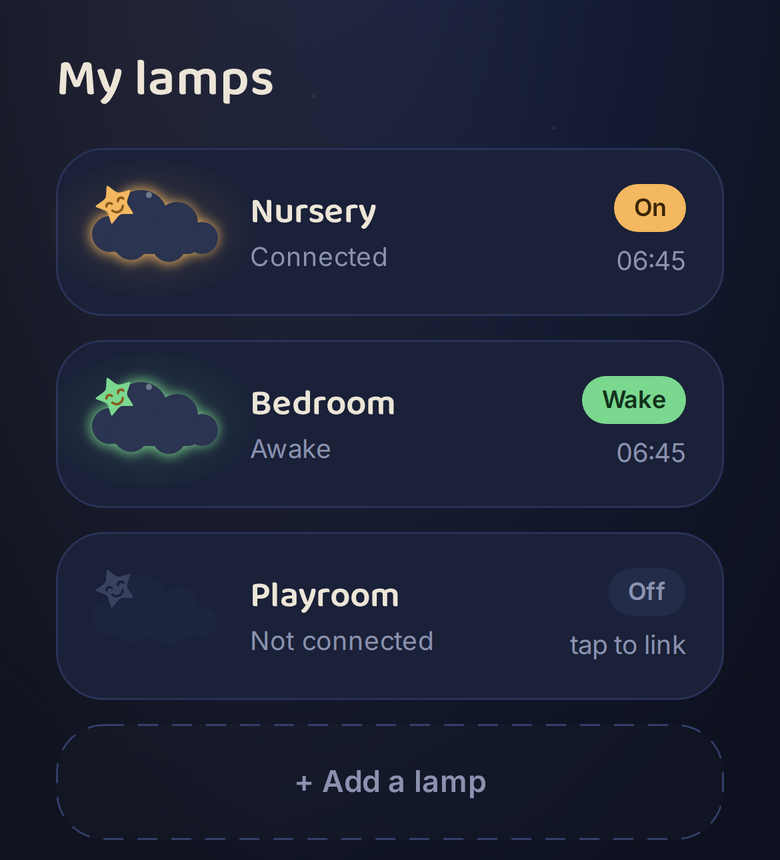
We built our own app for our own lamps: Rooster. It does what we needed ourselves, and nothing more remarkable than that. Lamps in a list, a night light setting, a time to wake up. The app talks to the lamp directly over Bluetooth, there is no account and no cloud.
The app is built on Appsemble, our open source low-code platform, so its definition can be read and changed. Anyone who wants to adjust it tomorrow, or run it themselves, can.
A replacement you actually want to use
Giving hardware a second life only works if the replacement software does not feel like a stopgap. Something you use at the moment you are putting a child to bed should not look like an admin screen.
That is why we put as much attention into how the app looks as into what it does: a dark theme that does not sting your eyes in a darkened room, custom illustrations for the lamps, a typeface of its own, and a list that shows at a glance what is on and when the light comes up.
That is also exactly why we take on projects like this. With low-code, design is quickly the poor relation, and it is one of the first reasons people leave an app alone. What we work out here about themes, custom fonts and visual building blocks lands back in the platform, and with it in the apps of everyone who uses Appsemble.
The same principle, a few sizes up
That idea, that things do not have to disappear because the process around them is missing, comes back in a very different project. For the Dutch Ministry of Justice and Security we built RePurposed, a pilot application that brings seized goods to organisations with a social purpose instead of to destruction.
There too, the technology is not the problem. The problem is that destruction is administratively the easiest route and reuse the hardest. Organisations register in RePurposed themselves and submit their own request, and an administrator approves or rejects it. What is left of the manual work is the assessment itself.
A night light and a depot full of seized goods have little to do with each other. The barrier is the same in both cases: there is no working way to give the thing a second life, so it disappears.
Software increasingly decides how long hardware lasts
Whoever buys a device with an app attached today is buying the lifespan of that app. That is rarely what the conversation is about at the time of purchase, and it is what decides in five years whether the thing can still do what it could.
Something can be done about that, and it does not have to be big. Local control instead of a mandatory cloud. An open protocol, or at the very least documentation. An app definition someone else can take over if the maker stops.
We would rather build software nobody has to replace if we fall over tomorrow. That is not only decent towards our customers. It also saves a pile of devices that worked perfectly well.
Appsemble and d-centralize are not affiliated with Mattel or Fisher-Price, and this article has not been approved or sponsored by them. Fisher-Price, Lumalou and Smart Connect are trademarks of their respective owners and are mentioned here only to refer to the product in question. Rooster was made by us for our own devices.